
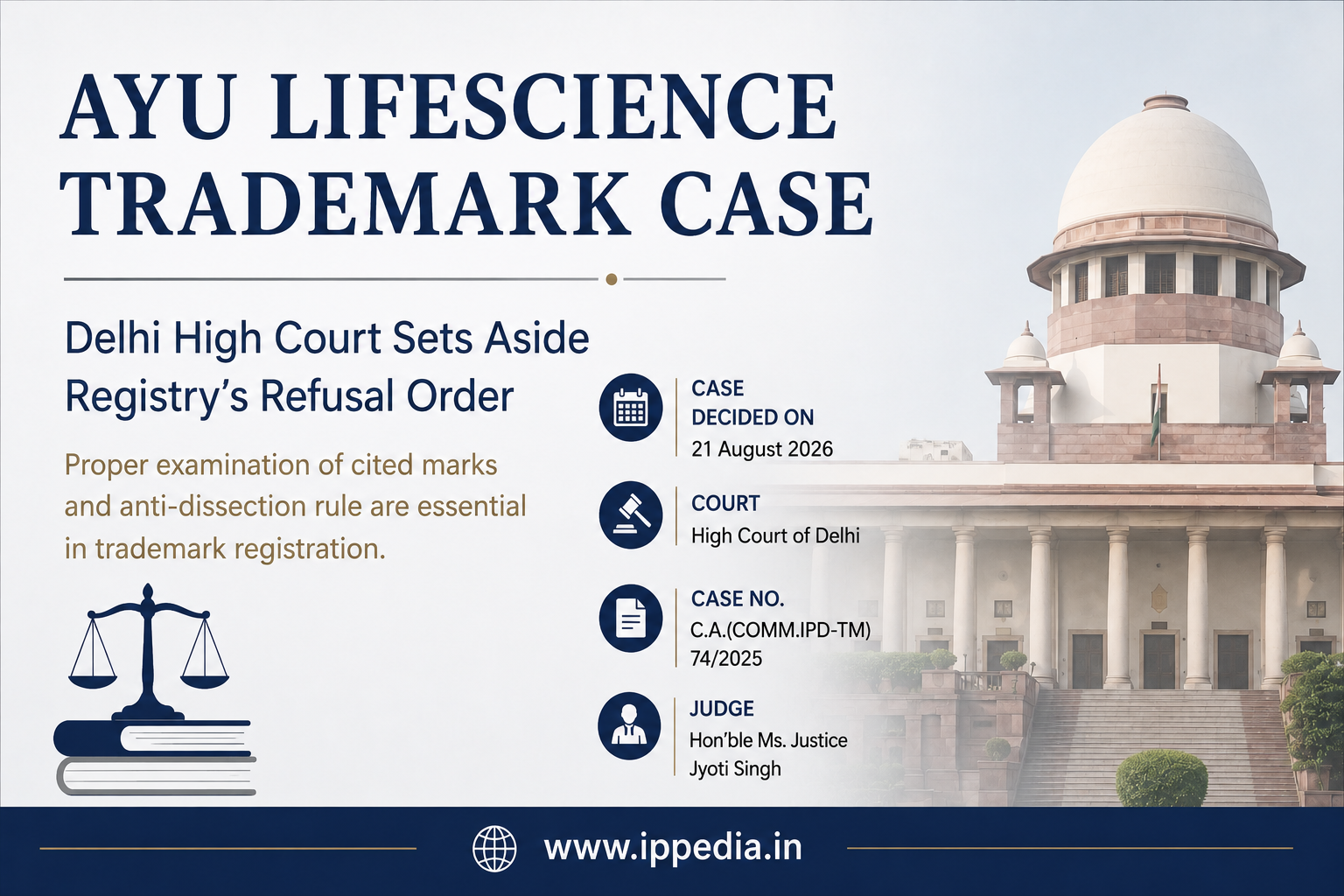
AYU LIFESCIENCE Trademark Case: Delhi High Court Sets Aside Registry’s Refusal Order
In an important trademark decision, the Delhi High Court set aside the Trademark Registry’s refusal order against the device mark AYU LIFESCIENCE. The case highlights the importance of properly examining the legal status of cited marks and comparing composite trademarks as a whole.
Quick Case Snapshot
Case: Ayu Lifescience Industries FZE v. The Controller General of Trademarks
Case No.: C.A.(COMM.IPD-TM) 74/2025
Court: High Court of Delhi
Decision Date: 21 August 2026
Background of the Dispute
Ayu Lifescience Industries FZE applied for registration of the device mark AYU LIFESCIENCE in Class 5. The Trademark Registry refused the application under Section 11(1) of the Trade Marks Act, 1999, relying on earlier cited marks including AYU, AYU18 and AYU SHAKTI.
The applicant challenged the refusal before the Delhi High Court, arguing that the cited marks were not all in the same legal position and that the applied mark was a composite device mark that needed to be examined in its entirety.
The Applicant’s Arguments
The applicant pointed out that the cited marks had different legal statuses and that their current status required proper examination before they could be relied upon as obstacles to registration.
- The cited mark AYU had remained under objection and was not properly prosecuted.
- The mark AYU SHAKTI was stated to be under opposition and pending.
- The mark AYU18 was the relevant registered mark relied upon by the Registry.
The applicant also argued that its mark consisted of more than the word AYU. The applied mark included AYU LIFESCIENCE together with a distinctive device element and overall visual presentation.
What Did the Delhi High Court Find?
The Delhi High Court found that the Trademark Registry had not properly examined the legal status of the cited marks before relying upon them to refuse the application.
The Court also found that the Registry was required to conduct a proper comparison between the applied mark and the relevant cited marks. The presence of a common word alone could not automatically determine whether two trademarks were deceptively similar.
The Importance of the Anti-Dissection Rule
One of the most important principles involved in the case was the anti-dissection rule.
A composite trademark should generally be considered as a whole. It should not be mechanically broken into separate elements with the analysis focusing only on one common word or component.
In this case, the presence of the word AYU in both marks could not, by itself, conclusively establish deceptive similarity. The overall visual appearance, additional words, device elements and commercial impression of the marks also required consideration.
Understanding the Anti-Dissection Rule
Trademark comparison should not be carried out by breaking a composite mark into individual parts and focusing exclusively on one common element.
Instead, the marks should be assessed based on their overall identity and the impression they create in the minds of consumers.
Common Elements and Trademark Similarity
The case demonstrates that the presence of a common word or element does not automatically mean that the later mark must be refused registration.
A proper trademark comparison may involve consideration of:
- Overall visual similarity;
- Phonetic similarity;
- Additional words and elements;
- Device or logo components;
- Nature of the goods or services;
- Legal status of the cited marks; and
- Likelihood of confusion among consumers.
What Did the Court Finally Order?
The Delhi High Court did not directly grant registration to the AYU LIFESCIENCE trademark.
Instead, the Court:
- Set aside the Trademark Registry’s refusal order;
- Remanded the matter for fresh consideration;
- Directed that the applicant be given an opportunity of hearing; and
- Directed the Trademark Registry to reconsider the application in accordance with law.
Key Takeaways
The legal status and relevance of cited marks must be properly examined before treating them as obstacles to registration.
Composite trademarks should be compared in their entirety and not merely on the basis of one common element.
Breaking a composite mark into separate parts and focusing on only one element can result in an incorrect comparison.
A shared word or element alone does not automatically establish deceptive similarity or likelihood of confusion.
Where the Registry fails to properly apply trademark principles, the refusal order may be challenged before the appropriate court.
Conclusion
The AYU LIFESCIENCE case is an important reminder that trademark examination should not be a mechanical exercise. Before refusing an application, the Trademark Registry must properly examine the cited marks and compare composite trademarks based on their overall identity and commercial impression.
The Delhi High Court’s decision reinforces an important trademark principle: the presence of one common word alone cannot automatically determine trademark similarity. Each case must be assessed on its own facts, taking into account the overall impression of the competing marks.