
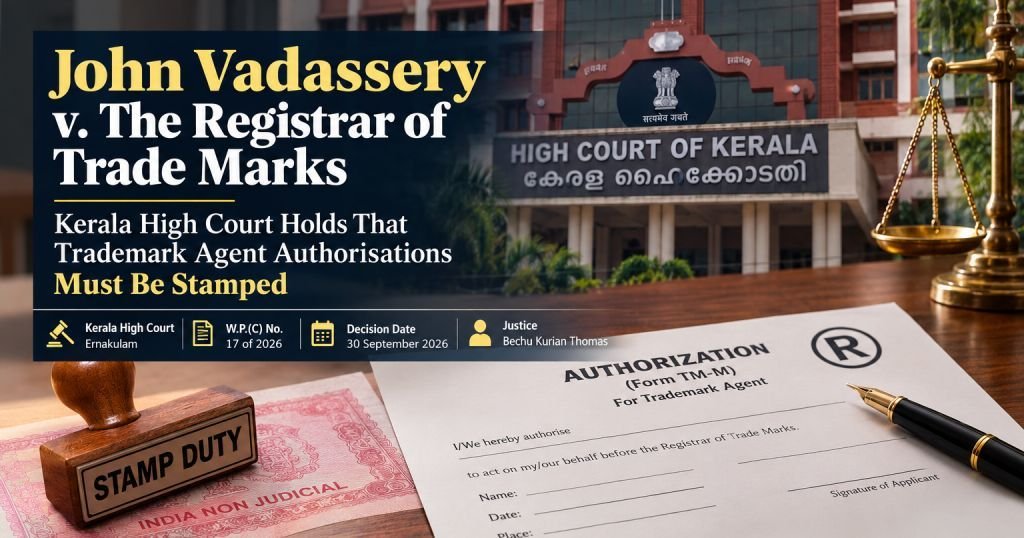
John Vadassery v. The Registrar of Trade Marks
Kerala High Court on Stamp Duty for Trademark Agent Authorisations
A detailed analysis of the judgment concerning Form TM-M, Power of Attorney and applicable stamp-duty requirements.
Case Name: John Vadassery v. The Registrar of Trade Marks
Court: High Court of Kerala at Ernakulam
Case Number: W.P.(C) No. 17 of 2026
Decision Date: 30 September 2026
Judge: Justice Bechu Kurian Thomas
Subject: Trademark Law and Stamp Duty
Introduction
The Kerala High Court's decision in John Vadassery v. The Registrar of Trade Marks concerns an important procedural issue in Indian trademark practice: whether an authorisation executed in favour of a trademark agent must be stamped under the applicable Stamp Act.
The dispute required the Court to consider Section 145 of the Trade Marks Act, 1999, Rule 19 of the Trade Marks Rules, 2017, and the relevant stamp legislation.
The prescribed trademark authorisation form and compliance with stamp-duty legislation are separate legal requirements. Using Form TM-M does not, by itself, establish an exemption from stamp duty.
Background of the Dispute
John Vadassery, an advocate and trademark attorney, approached the Kerala High Court under Article 226 of the Constitution of India. He challenged the requirement that an authorisation given to a trademark agent should bear stamp duty applicable to a Power of Attorney.
The petitioner argued that the Trade Marks Act and the Trade Marks Rules already provide a mechanism for appointing an authorised representative. According to him, a separate requirement to stamp the authorisation as a Power of Attorney was not justified merely because an agent was appointed.
The central question was whether the authorisation was merely a procedural permission or an instrument attracting stamp duty under the applicable legislation.
Petitioner's Arguments
A. Section 145 of the Trade Marks Act
Section 145 permits a person to act through a duly authorised representative in the prescribed manner. The petitioner argued that the provision does not expressly require a separately executed Power of Attorney.
B. Rule 19 and Form TM-M
Rule 19 of the Trade Marks Rules, 2017, prescribes the procedure for authorising an agent through Form TM-M. The petitioner contended that compliance with this procedure should be sufficient for representation before the Registry.
C. Authorisation on Plain Paper
The petitioner maintained that an authorisation should not automatically be treated as a Power of Attorney attracting stamp duty.
Respondents' Arguments
The respondents defended the Registry's requirement. An authorised trademark agent can act on behalf of an applicant, receive official communications and undertake procedural steps in trademark proceedings.
The respondents' position was that the document confers legal authority on the agent and must comply with the applicable stamp legislation. Prescribing a particular form under trademark law does not necessarily exempt the document from stamp duty.
Section 145 of the Trade Marks Act, 1999
Section 145 provides the statutory framework for representation before the Registrar of Trade Marks. Subject to statutory requirements, acts before the Registrar may be performed through an authorised legal practitioner, a registered trademark agent, or a person in the sole and regular employment of the principal.
The ability to appoint an agent, however, is distinct from the question of whether the instrument used to grant that authority is liable to stamp duty.
Rule 19 of the Trade Marks Rules, 2017
Rule 19 provides for authorisation of an agent in the prescribed manner through Form TM-M. It also addresses service of documents on the authorised agent.
The prescribed form and the stamp-duty requirement address different legal aspects. Compliance with Form TM-M does not necessarily settle the separate question of stamp duty.
Why Does Stamp Duty Apply?
The Court examined the legal effect of the authorisation and the relevant definitions under the applicable stamp legislation. The important question was whether the document merely records an informal permission or creates authority in favour of another person to act on behalf of the principal.
A. Instrument
The relevant definition of an instrument under the Kerala Stamp Act, 1959, covers documents through which rights or liabilities are created, transferred, limited, extended, extinguished or recorded, subject to the statutory wording.
B. Power of Attorney
The definition of Power of Attorney under the applicable stamp legislation concerns an instrument empowering a person to act for and in the name of the person executing it.
An authorisation allowing a trademark agent to represent an applicant before the Registry gives the agent legal authority to perform acts on the applicant's behalf. The Court treated this legal character as central to the stamp-duty question.
Distinction Between Court Fees and Stamp Duty
The judgment considered the distinction between documents filed before a court and authorisations filed before the Registrar of Trade Marks.
The Registrar is not a court or tribunal merely because the Registrar performs statutory functions. The treatment of a vakalatnama under court-fee legislation cannot automatically be extended to an authorisation filed before the Trade Marks Registry.
Earlier Judicial Authority
The Court referred to The Institute of Chartered Accountants of India v. Union of India and Others, reported as 2002 SCC OnLine Ker 675, concerning authorisations submitted before taxing authorities.
The discussion supported the principle that an authorisation submitted to a statutory authority may attract stamp duty under the relevant stamp legislation. Its administrative use does not automatically remove the obligation to pay stamp duty.
Final Decision of the Kerala High Court
The Kerala High Court dismissed the writ petition and declined to grant the declarations sought by the petitioner.
The central conclusion was that the authorisation contemplated under Section 145 of the Trade Marks Act, read with Rule 19 of the Trade Marks Rules, must comply with the applicable stamp-duty requirements.
The prescribed authorisation form does not, by itself, displace the applicable stamp legislation.
Practical Implications for Trademark Agents
A. Use the Prescribed Form
Applicants and trademark agents should follow the prescribed procedure for authorisation, including applicable requirements relating to Form TM-M.
B. Verify Stamp Duty Separately
The prescribed form should not be treated as an automatic exemption from stamp duty. The relevant stamp legislation must be checked independently.
C. Consider the Place of Execution
The judgment identifies the place where the instrument is executed as relevant to determining the applicable Stamp Act. The parties should record the actual place and date of execution accurately.
D. Cross-State Execution and Use
Where a document is executed in one State and later used or received in another, any applicable provisions concerning instruments brought into or received in the second State should also be examined. The judgment should not be read as conclusively resolving every possible cross-State stamping scenario.
Does the Judgment Fix a Uniform Stamp Duty?
No. The judgment does not prescribe one uniform stamp-duty amount for all trademark agent authorisations throughout India. The applicable amount depends on the relevant Stamp Act, the classification of the instrument and the circumstances of its execution.
Frequently Asked Questions
1. Is stamp duty required on Form TM-M?
The Kerala High Court held that the prescribed authorisation must comply with the applicable stamp legislation. The use of Form TM-M does not, by itself, establish an exemption.
2. Can an authorisation be executed on plain paper?
The judgment rejects the general argument that an authorisation is exempt from stamp duty merely because trademark rules prescribe a form. The applicable Stamp Act must be examined.
3. Is stamp duty the same in every Indian State?
No. Stamp-duty requirements may vary under the applicable State legislation. The judgment does not establish a uniform all-India amount.
4. Does the place of execution matter?
Yes. The judgment refers to the relevant Stamp Act applicable where the instrument is executed. Cross-State use may require further examination of the relevant legislation.
5. What was the outcome of the case?
The Kerala High Court dismissed the writ petition and declined to grant the declarations sought by the petitioner.
Conclusion
John Vadassery v. The Registrar of Trade Marks highlights the importance of considering stamp-duty requirements separately from procedural authorisation requirements under trademark law.
The decision is relevant to trademark applicants, advocates and registered trademark agents who regularly deal with authorisations before the Trade Marks Registry. The practical lesson is to comply with the prescribed trademark procedure and verify the applicable stamp legislation before executing the document.