
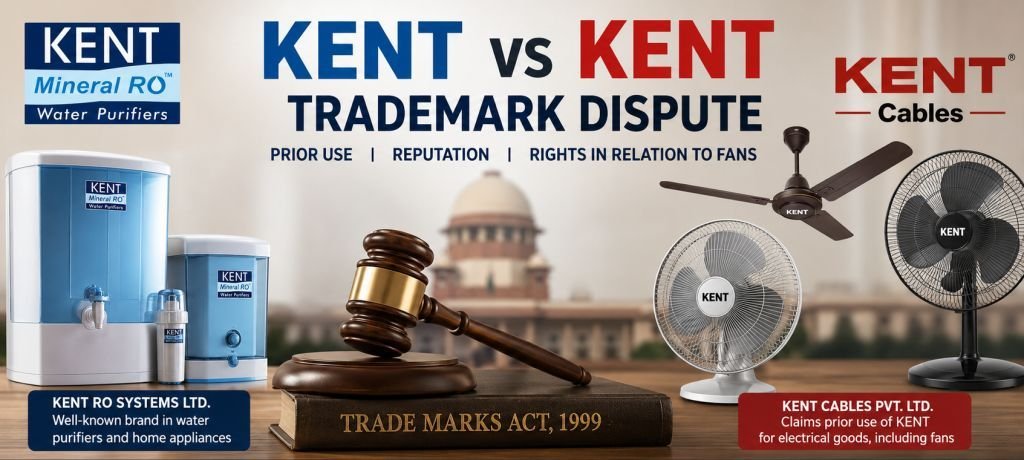
KENT vs KENT: Trademark Rights, Prior Use and the Battle Over Fans
Can a reputed trademark owner stop an earlier user from using the same mark for a specific product?
The trademark dispute between Kent RO Systems Ltd. and Kent Cables Pvt. Ltd. provides an important insight into the principles of prior use, passing off, trademark reputation, acquiescence and interim injunctions.
The dispute centres around the identical trademark “KENT” in relation to fans. What makes the case particularly interesting is that both parties claimed substantial rights and reputation in the mark, but their histories of adoption and use were different.
Background of the Parties
Kent RO Systems Ltd. is associated with the KENT brand in water purifiers, air purifiers, kitchen appliances and other home appliances. According to its case before the Delhi High Court, the KENT mark was adopted by its promoter in 1988 for oil meters under the mark “KENT OIL METERS”. The mark was registered in Class 9 in 1994.
Kent RO subsequently entered the domestic water purifier market in 1999 under the KENT trademark and expanded into other home appliances, including air purifiers in 2006.
On the other side, Kent Cables Pvt. Ltd. claimed adoption of the KENT mark as early as 1984 for insulated wires, cables, switches and allied electrical components. Its first registration for KENT was obtained in 1986, claiming user from 1 September 1986.
Key Fact: Kent Cables' claimed adoption and first registration of KENT pre-dated Kent RO's adoption and registration relied upon in the proceedings.
How Did the Dispute Reach the Court?
Kent Cables claimed that it had been using the KENT mark for fans as well. It had also sought registration of the KENT mark for fans in Class 11 in 1998.
Kent RO opposed the application in 2007 and subsequently issued a cease-and-desist notice in 2011, objecting to Kent Cables' use of KENT for fans.
Despite this knowledge, litigation concerning the use of KENT for fans arose much later, when Kent RO proposed to enter the fan market.
The dispute ultimately resulted in cross-suits before the Delhi High Court in 2022.
The Fan Business Became the Main Battleground
Kent RO claimed that fans were allied and cognate to its existing home-appliance products and sought protection for its use of KENT.
Kent Cables, however, argued that it was already using KENT for fans and had built goodwill in that market before Kent RO entered the fan business.
Kent RO also stated that it had invested approximately ₹155 crore and employed around 500 people in preparation for its fan business.
However, the Court had to examine the existing rights of the parties rather than merely the investment made by the proposed entrant.
Evidence of Kent Cables' Use of KENT for Fans
Kent Cables placed substantial documentary material before the Court to establish its use of KENT for fans.
The material referred to in the proceedings included:
- Invoices for KENT fans dating from 2009 onwards
- E-commerce invoices from platforms including Amazon, Flipkart, Snapdeal and Paytm
- Product packaging and shipment records
- Advertisements on television channels including Aaj Tak and Zee News
- Hoarding and advertising invoices
- Government and institutional approvals
- Bureau of Energy Efficiency approval from 2011
- Public Works Department approvals
- Vendor registration with Mata Vaishno Devi Shrine Board
- Marketing brochures and catalogues
- Photographs of dealers and distributors selling KENT fans
The Division Bench noted that these materials prima facie supported Kent Cables' use of KENT for fans from at least 2009, while the Single Judge had referred to material showing fan sales from at least 2006.
Important: In a prior-user dispute, historical commercial evidence can be more important than simply producing a trademark registration certificate.
Delhi High Court Single Judge: 30 May 2023
On 30 May 2023, the Delhi High Court considered the interim injunction applications in the cross-suits.
The Court found that Kent Cables had made out a prima facie case of prior user and passing off in relation to fans.
The Court noted that Kent Cables had been selling fans under KENT for years, while Kent RO had not yet launched its KENT-branded fans.
The Court therefore restrained Kent RO from manufacturing and selling fans under the KENT trademark during the pendency of the suit and dismissed Kent RO's application seeking an injunction against Kent Cables.
The Court specifically considered the principles of prior user, goodwill, likelihood of confusion, balance of convenience and irreparable injury.
Important Principle: At the interim stage, the “first in the market” principle can carry substantial weight in a passing-off dispute.
What About Kent RO's Reputation?
Kent RO relied heavily upon the reputation and goodwill associated with its KENT brand in water purifiers and other appliances.
However, the Court had to consider whether that reputation could override the rights claimed by an earlier user in relation to fans.
The Court found that permitting Kent RO to launch identical KENT-branded fans could create confusion among consumers, particularly because the competing marks were identical and the product in question was also identical.
The issue was therefore not merely which party had the bigger brand, but which party had protectable rights in the relevant market.
Same Class Does Not Automatically Mean Same Goods
Another important issue concerned the classification of the goods.
Kent RO relied upon its registrations in various classes, including Class 11, and argued that fans were allied and cognate to its home appliances.
The Court, however, emphasized that trademark classification by itself does not determine whether two goods are similar or allied and cognate.
The actual nature of the goods, commercial relationship, trade channels and consumer perception must be considered.
Important Principle: “Same Class” does not automatically mean “Same Goods” or “Similar Goods.”
Acquiescence and the 2011 Cease-and-Desist Notice
One of the particularly significant facts was that Kent RO had knowledge of Kent Cables' use of KENT for fans.
The record referred to Kent RO's opposition to Kent Cables' trademark application in 2007 and the cease-and-desist notice issued in 2011.
Despite this knowledge, Kent RO did not obtain an injunction preventing Kent Cables from continuing its fan business at that stage.
The Court considered this conduct relevant while examining Kent RO's entitlement to discretionary interim relief.
Important Principle: Knowledge of conflicting use followed by prolonged inaction can become highly relevant when seeking an interim injunction.
Division Bench of Delhi High Court: 11 March 2026
Kent RO challenged the Single Judge's order through FAO(OS)(COMM) 141/2023 and FAO(OS)(COMM) 142/2023.
The appeals were heard by a Division Bench comprising Justice Navin Chawla and Justice Madhu Jain.
The judgment was pronounced on 11 March 2026.
The Division Bench upheld the interim position in favour of Kent Cables and declined to grant Kent RO an interim injunction against Kent Cables in relation to fans.
The Court observed that Kent Cables had prior adoption of the KENT mark for electrical goods and had placed material showing use of KENT for fans. It further noted that Kent RO had remained inactive for a considerable period despite knowledge of Kent Cables' use.
Key Finding: The prior use of KENT by Kent Cables for fans was sufficient, at the interim stage, to disentitle Kent RO from obtaining an injunction against Kent Cables.
Prior User Rights: The Core Legal Principle
The Division Bench relied upon established Supreme Court principles relating to prior users and passing off, including Wander Ltd. v. Antox India P. Ltd., S. Syed Mohideen v. P. Sulochana Bai and Neon Laboratories Ltd. v. Medical Technologies Ltd.
The Court reiterated that rights arising from passing off are rooted in common law and that, in appropriate circumstances, prior-user rights can prevail over those of a subsequent user, even where the subsequent user has obtained registration.
Prior Use + Goodwill + Likelihood of Confusion can become a powerful combination in a passing-off action.
Why Is the KENT Case Important?
-
Prior Use Matters
An earlier genuine user can have strong rights even against a later registered proprietor.
-
Registration Is Not Absolute
A registration certificate does not automatically eliminate the statutory and common-law rights of a prior user.
-
Reputation Has Limits
A reputed trademark in one product category does not automatically guarantee an unrestricted right to enter every other category.
-
Classification Is Not Conclusive
Products falling in the same trademark class are not automatically treated as identical or similar.
-
Delay Can Affect Interim Relief
Knowledge of another party's use and prolonged inaction can affect the equitable discretion of the Court.
-
Evidence Is Critical
Invoices, advertisements, packaging, government approvals, e-commerce records and other historical documents can be crucial in proving prior use and goodwill.
The Bigger Trademark Lesson
The KENT dispute demonstrates an important lesson for businesses expanding an established brand into new product categories.
Before entering a new market, a proprietor should conduct not only a trademark registry search but also a broader market and common-law search.
- Search for prior users
- Check identical and deceptively similar marks
- Review allied and cognate goods
- Examine actual market use
- Check common-law rights and goodwill
- Review earlier opposition and litigation history
- Assess potential consumer confusion
Before expanding a brand, search the market—not just the Trademark Registry.
Conclusion
The KENT vs KENT dispute is a significant example of how Indian trademark law balances brand reputation and registration against prior use and established goodwill.
Kent RO had substantial goodwill in the KENT mark for water purifiers and other home appliances. However, Kent Cables relied upon its earlier adoption of KENT in the electrical goods sector and documentary evidence supporting its use of KENT for fans.
At the interim stage, both the Single Judge and the Division Bench of the Delhi High Court found the balance of convenience in favour of Kent Cables and maintained the restraint against Kent RO's use of KENT for fans.
The case therefore reinforces a fundamental trademark principle:
A powerful brand may have extensive reputation, but prior use and established goodwill in the relevant product market cannot simply be ignored.
Disclaimer: This article is intended for general information and educational purposes only and does not constitute legal advice. The observations discussed above relate to the interim stage of the proceedings and should not be treated as a final adjudication on the substantive trademark rights of the parties.