
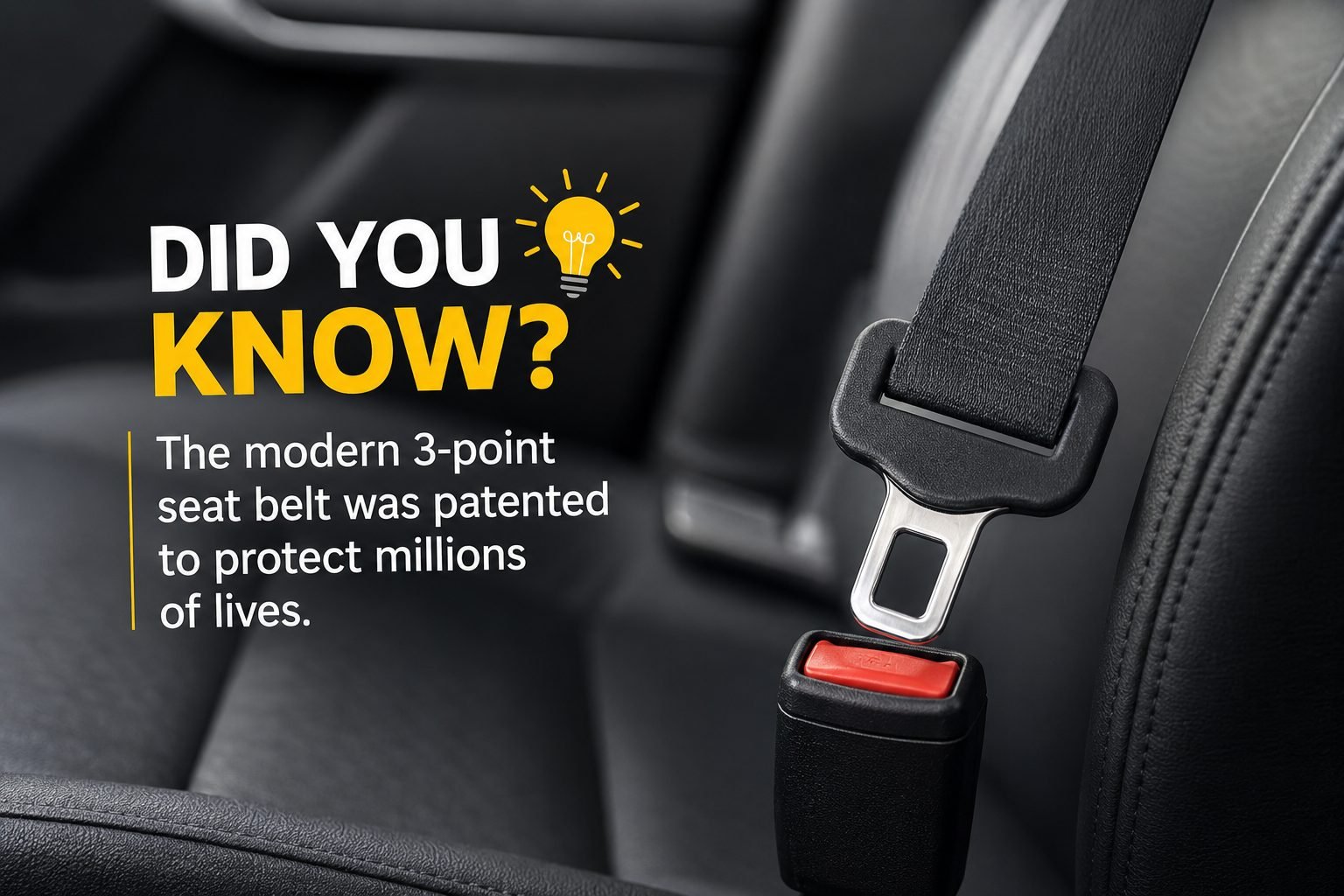
Did You Know? The Modern Seat Belt Was Patented
A remarkable patent story about innovation, safety and public benefit.
The seat belt is one of the most familiar safety features in every modern car. But did you know that the modern three-point seat belt was patented?
Even more interesting is the fact that the technology was made widely available to other automobile manufacturers, allowing the invention to benefit people far beyond a single company.
Who Invented the Modern Three-Point Seat Belt?
The modern three-point safety belt was developed by Swedish engineer Nils Ivar Bohlin while working at Volvo.
Bohlin had previously worked on aircraft safety systems. At Volvo, he focused on developing a safer restraint system for automobile occupants.
The invention dates back to 1958, with a Swedish priority date of 29 August 1958.
The design combined a lap belt with a diagonal upper-body belt, helping to restrain both the upper and lower body of an occupant during a collision.
Was the Seat Belt Actually Patented?
Yes. The modern three-point safety belt was patented.
One important patent associated with Nils Bohlin's invention is U.S. Patent No. 3,043,625 – “Safety Belt”.
Patent Details
- Inventor: Nils Ivar Bohlin
- Assignee: Volvo AB
- Priority Date: 29 August 1958
- U.S. Filing Date: 17 August 1959
- U.S. Grant Date: 10 July 1962
- Patent: US 3,043,625
- Current Status: Expired – Lifetime
Therefore, the statement that “the seat belt was never patented” is incorrect. The three-point seat belt was indeed the subject of patent protection.
Why Did Volvo Make the Technology Available to Others?
This is perhaps the most remarkable part of the story.
Volvo made the three-point seat belt technology available to other automobile manufacturers so that the safety innovation could be adopted more widely.
Instead of limiting the technology only to Volvo vehicles, the company supported its wider adoption across the automobile industry.
Did Volvo Give Away a “Worldwide Patent”?
Not exactly.
This is where an important principle of Intellectual Property Law comes into play:
Patent Rights Are Territorial
A patent does not automatically provide worldwide protection. Patent rights are generally available and enforceable within the country or applicable jurisdiction where protection has been obtained.
Therefore, a U.S. patent does not automatically create patent rights in India, the United Kingdom, Germany or every other country.
The seat belt story should therefore not be described as a “worldwide patent given away for free.” A more accurate description is that the patented technology was made widely available to other automobile manufacturers.
Could the Same Seat Belt Be Patented in India Today?
No, not as the same old invention.
The reason is not simply whether the original patent was filed in India. The concepts of novelty and prior art are also critical.
Under Indian patent law, an invention must satisfy the applicable requirements of patentability, including novelty and inventive step.
An invention that has already been publicly disclosed or forms part of the prior art cannot normally become a new invention merely because someone attempts to patent it in another country many years later.
Why Is Foreign Prior Art Relevant in India?
Suppose someone tried to file a patent application in India today for the same three-point seat belt design developed in the 1950s.
The fact that the inventor may not have an Indian patent for that old invention would not make the invention new.
Earlier publications and disclosures from outside India can be relevant when assessing patentability in India.
Territoriality and Prior Art Are Two Different Concepts
1. Territoriality
Patent rights are generally jurisdiction-specific. A patent granted in one country does not automatically provide enforceable patent rights worldwide.
2. Novelty and Prior Art
When a patent application is examined, earlier disclosures can be relevant to determining whether the claimed invention is new and inventive.
This distinction is extremely important in patent practice: the territorial scope of a patent and the worldwide relevance of prior disclosures are separate legal concepts.
Can a New Seat Belt Invention Be Patented Today?
Yes.
While the old three-point seat belt design cannot simply be patented again as a new invention, a genuinely new technical improvement may potentially qualify for patent protection if it satisfies the applicable legal requirements.
Examples may include:
- Novel automatic restraint mechanisms
- Improved seat belt buckle technology
- Advanced occupant protection systems
- Sensor-based restraint adjustment
- Intelligent crash-response systems
- Novel seat-belt deployment mechanisms
However, merely making an obvious or routine modification to an existing seat belt would not necessarily satisfy the requirements for patent protection.
What Can IP Professionals Learn From This Story?
Patent Does Not Mean Worldwide Monopoly
Patent rights are generally territorial.
A Foreign Patent and an Indian Patent Are Different
A patent granted in another country does not automatically provide patent protection in India.
Foreign Publications Can Matter
Earlier disclosures from outside India can be relevant when analysing novelty and prior art.
Patent Rights and Prior Art Are Different Issues
The territorial scope of a patent should not be confused with the prior-art effect of an earlier disclosure.
IP Can Serve a Wider Purpose
The seat belt story demonstrates how an invention protected through Intellectual Property can also have a significant public-safety impact.
A Patent That Helped Protect People
Nils Bohlin's three-point seat belt is a remarkable example of engineering, innovation and Intellectual Property coming together to address a real-world safety problem.
The invention was patented, but its wider availability helped the technology spread throughout the automobile industry.
Some patents protect inventions. Some inventions help protect lives.
IPPEDIA Takeaway
“A patent may be territorial, but innovation can have a global impact.”
The seat belt story reminds us that understanding Intellectual Property requires more than simply asking where a patent was granted.
For proper patent analysis, we should ask:
- When was the invention filed?
- Where was protection sought?
- Who was the inventor and applicant?
- What exactly was disclosed?
- Is the patent still active?
- Does the disclosure constitute prior art?
These questions form an important part of effective patent due diligence and IP analysis.
Important Note
This article is intended for general Intellectual Property awareness and educational purposes only. Patentability, infringement, validity and prior-art issues should be evaluated based on the complete patent records and applicable law in the relevant jurisdiction.