
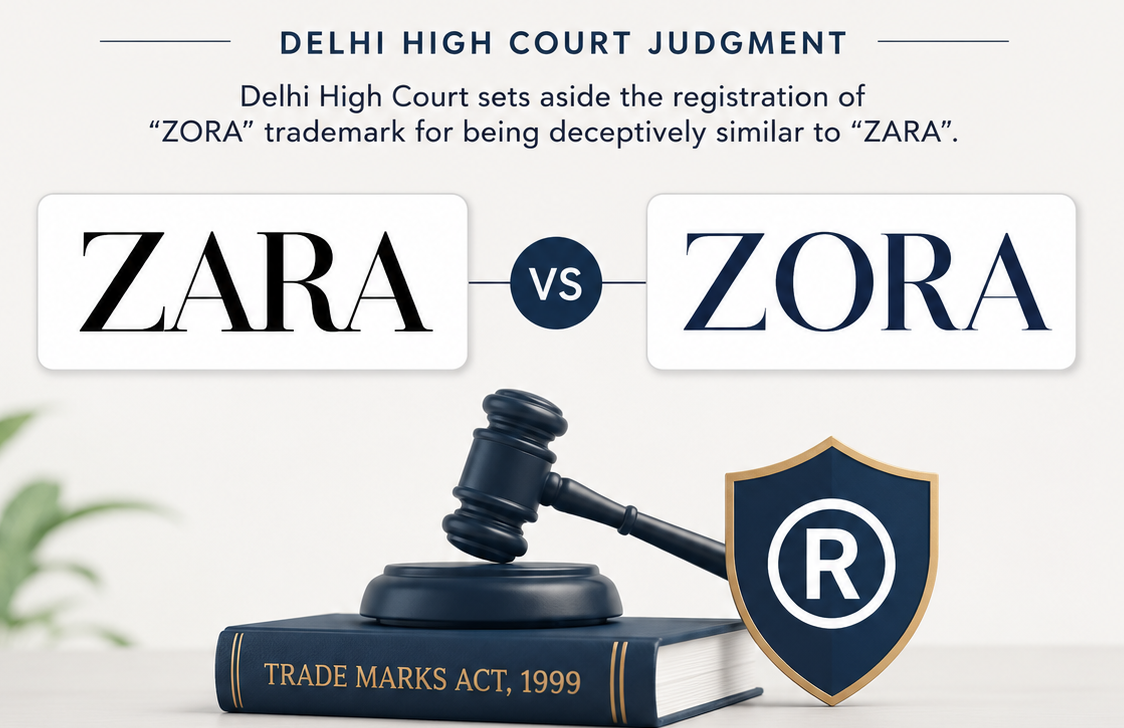
ZARA vs ZORA Trademark Case: Delhi High Court Cancels Registration of "ZORA"
Introduction
The Delhi High Court has delivered a significant judgment on the law relating to deceptive similarity and the protection of reputed trademarks under the Trade Marks Act, 1999. In Industria De Diseño Textil, S.A. v. Registrar of Trade Marks & Anr., C.A. (COMM.IPD-TM) 52/2024, the Court allowed the appeal filed by the proprietor of the trademark ZARA, set aside the order of the Registrar of Trade Marks, and directed the removal of the trademark ZORA from the Register of Trade Marks.
The judgment clarifies that while deciding an opposition under Section 11 of the Trade Marks Act, the Registrar must independently examine the reputation of the earlier trademark and cannot reject protection merely because the mark has not been formally declared as a "well-known trademark."
Case Details
| ||||||||||||||||||||
|---|---|---|---|---|---|---|---|---|---|---|---|---|---|---|---|---|---|---|---|---|
Background
The Appellant, Industria De Diseño Textil, S.A. (popularly known as Inditex), is the proprietor of the internationally recognized trademark ZARA.
The Respondent had obtained registration of the trademark ZORA in Class 24. Believing that the impugned mark was deceptively similar to its earlier trademark, the Appellant filed an opposition before the Trade Marks Registry.
However, the Registrar rejected the opposition and permitted registration of the impugned mark. Aggrieved by the decision, the Appellant approached the Delhi High Court by way of an appeal under Section 91 of the Trade Marks Act, 1999.
Questions Before the Court
The High Court examined the following issues:
Whether the Registrar correctly appreciated the evidence placed on record.
Whether the trademark ZORA is deceptively similar to ZARA.
Whether protection under Section 11(2) is available only after a trademark is formally declared well-known.
Whether registration of the impugned mark was liable to be cancelled.
Arguments of the Appellant
The Appellant contended that:
ZARA is an earlier trademark having substantial goodwill and reputation.
The competing marks are visually, structurally and phonetically similar.
The impugned registration is prohibited by Section 11 of the Trade Marks Act.
Consumers are likely to associate the impugned mark with the Appellant's brand.
The Registrar ignored the documentary evidence relating to the reputation of ZARA.
Registrar's Approach
The Registrar had concluded that since ZARA had not been formally recognized as a "well-known trademark," the protection contemplated under Section 11(2) was not available.
Consequently, the opposition was dismissed.
Findings of the Delhi High Court
1. Interpretation of Section 11(2)
The Court observed that the Registrar had adopted an incorrect interpretation of Section 11(2).
According to the Court, the statute does not require a trademark to be formally declared as a well-known trademark before seeking protection under Section 11(2). The relevant question is whether, on the basis of the evidence produced, the earlier trademark is entitled to such protection.
The Court held that the Registrar must independently evaluate the evidence instead of relying only on the official list of well-known trademarks.
2. Assessment of Reputation
The Court examined the documents produced by the Appellant and found that the material demonstrated the reputation, commercial recognition and goodwill associated with the trademark ZARA.
The Court held that these materials deserved proper consideration while deciding the opposition proceedings.
3. Comparison of the Competing Marks
While comparing the rival marks, the Court emphasized that trademarks should be compared as a whole.
The Court observed:
Both marks consist of four letters.
The overall structure of the marks is almost identical.
The only difference is substitution of the vowel "A" with "O".
The visual appearance, pronunciation and overall commercial impression are substantially similar.
The Court therefore concluded that the impugned mark is deceptively similar to the earlier trademark.
4. Test of an Average Consumer
The Court reiterated the settled principle that trademark comparison is made from the perspective of an ordinary purchaser having imperfect recollection.
Such a consumer is unlikely to remember minute spelling differences and may associate the impugned mark with the earlier trademark.
5. Likelihood of Confusion
After considering the competing marks in their entirety, the Court concluded that registration of ZORA was likely to result in confusion and association with ZARA.
Accordingly, the impugned registration was held to be contrary to the provisions of Section 11 of the Trade Marks Act, 1999.
Final Decision
The Delhi High Court:
Allowed the appeal.
Set aside the order dated 08 February 2024 passed by the Registrar of Trade Marks.
Directed removal of Trademark Registration No. 4310686 for the mark ZORA from the Register of Trade Marks.
Key Legal Principles Emerging from the Judgment
The judgment reinforces several important principles of trademark law:
Protection under Section 11(2) is not confined to trademarks that have already been formally declared well-known.
The Registrar has a duty to independently evaluate the evidence relating to reputation and goodwill.
Deceptive similarity must be assessed on the basis of the overall impression created by the marks.
Minor spelling variations cannot avoid confusion if the competing marks are visually, structurally and phonetically similar.
The perspective of an average consumer with imperfect recollection remains the governing test while assessing deceptive similarity.
Why This Judgment is Important
The decision is significant for trademark proprietors, legal practitioners and businesses because it clarifies the approach to be adopted while examining claims involving reputed trademarks.
The judgment also serves as a reminder that adopting a mark with only a slight variation from an established trademark may still result in refusal or cancellation if the overall commercial impression is likely to mislead consumers.
Conclusion
The Delhi High Court's decision in ZARA vs ZORA strengthens the protection available to earlier and reputed trademarks under the Trade Marks Act, 1999. It reiterates that the Registrar must undertake an independent assessment of the evidence and cannot deny protection solely because a trademark has not been formally recognised as well-known.
The judgment also reaffirms the settled principles governing deceptive similarity and consumer confusion, making it an important precedent for future trademark opposition and cancellation proceedings in India.